The codec conversation used to stay inside the encoding lab. Engineers ran BD-rate comparisons, production teams argued over toolchains, and viewers had no idea any of it was happening. That’s no longer the case. AV1 has crossed into mainstream gaming broadcast infrastructure fast enough that even mid-tier tournament organizers are starting to ask their streaming vendors which codec they’re actually running.
The answer, more often than spring 2025, is AV1. And the pace of that shift is not gradual.
Why Are Gaming Streaming Platforms Moving to AV1 Right Now?
The short version: the royalty-free model finally tipped the math. H.264 charges licensing fees through the Via Licensing pool, and HEVC’s patent situation is still messy enough that legal teams in 2026 treat it as a liability. AV1, built by the Alliance for Open Media with backing from Google, Netflix, and Meta, has no licensing cost at all. For a platform streaming 1,000 hours of CS2 or League of Legends tournament footage per day, that math gets serious quickly.
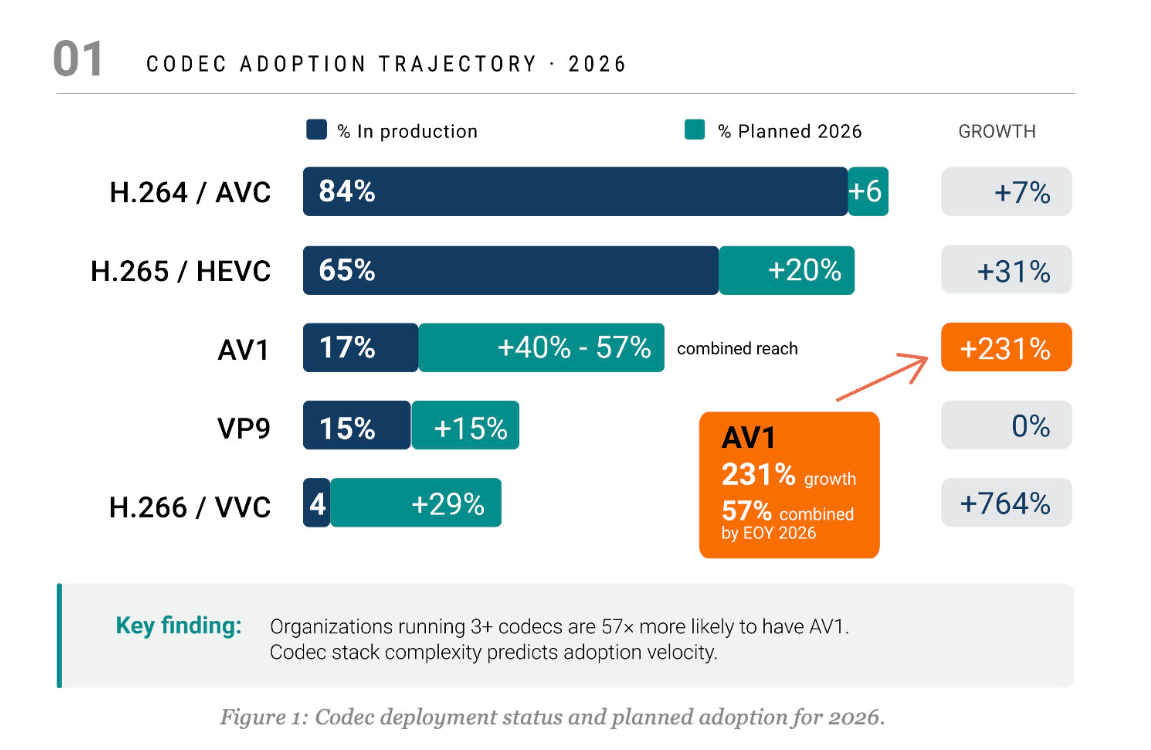
New survey data from NETINT’s 2026 State of Video Encoding report, published March 30 and analyzed by streaming industry analyst Dan Rayburn, found that 40% of respondents plan to deploy AV1 in 2026, which would bring the codec’s combined reach to 57% of the market by year-end. That’s not a trend. That’s a transition. Rayburn’s post on streamingmediablog.com breaks down the survey methodology: 286 industry professionals responded, with live sports and esports broadcasting accounting for 35% of the sample — the single largest vertical in the entire dataset.
What Does 40% Planned Deployment Actually Mean for Esports Broadcasts?
It means the infrastructure underneath major gaming events is changing faster than the viewer-facing product suggests. When you watched Natus Vincere play at IEM Cologne 2025, you probably weren’t thinking about codec architecture. But the team running the broadcast almost certainly was.
YouTube already delivers over 75% of video playback using AV1, up from roughly 50% in 2024, while Meta routes more than 70% of video across Facebook and Instagram through AV1 on supported devices. Both platforms host major esports content. ESL events stream live on YouTube, BLAST Premier uses both YouTube and Twitch, and Riot Games’ Valorant Champions broadcasts routinely pull over a million peak concurrent viewers. The codec those streams run on directly affects how many people buffer out before a clutch round.
At equivalent perceptual quality, AV1 delivers the same visual quality at 56% less bitrate than H.264, and around 30-35% less than HEVC — with the advantage widening on high-motion content like sports and gaming specifically. For a viewer on a 15 Mbps connection watching a fast-paced Dust2 rotation, that compression gap is the difference between clean 1080p60 and a pixelated mess during a smoke throw.
Why Wasn’t AV1 Dominant in Gaming Streams Two Years Ago?
Hardware decode support was the wall. A codec is only useful if the device playing it can decode it without burning through CPU. Netflix reports that 88% of large-screen devices submitted for certification between 2021 and 2025 support AV1, with virtually all devices since 2023 featuring native AV1 playback up to 4K at 60fps. The device ecosystem finally caught up in 2023-2024, and encoding pipelines are now following.
The barriers that remain are worth understanding. According to the NETINT survey, hardware decode support still leads as the top barrier at 54% of respondents citing it, followed by toolchain limitations at 43% and encoding compute costs at 37%. Licensing issues, by contrast, were cited by fewer than 1% of respondents — which is the clearest signal that the format war is essentially settled. AV1 won that battle before it started.
There’s also a usage pattern worth noting from Reddit’s r/streaming community, where encoder operators have been openly discussing the shift since late 2024. One thread in r/limelight from November 2025 showed broadcast engineers at mid-size esports production companies reporting that their CDN costs dropped 20-30% after switching to AV1 output for VOD archives, though live encoding costs went up until they moved to hardware encoders. That tradeoff — higher upfront compute, lower delivery cost — is exactly what the NETINT data reflects.
Which Gaming Platforms Are Actually Running AV1 in Production?

Netflix serves approximately 30% of all streams via AV1, prioritizing devices with hardware decode support, driven by direct CDN cost savings from smaller files. That’s not primarily a gaming context, but it trained device manufacturers to build AV1 decode hardware — and that hardware is now inside the gaming PCs, smart TVs, and mobile phones that esports audiences use.
AV1 is projected to triple its production footprint in 2026, with nearly 50% of video streaming professionals also evaluating Video Processing Units as an alternative to GPU-based encoding pipelines. VPUs matter here because they’re purpose-built for codec work — they draw less power and handle more concurrent streams than a general GPU. For a company encoding 50 simultaneous tournament streams during a major LAN event, that’s not a theoretical saving.
The gaming streaming context specifically sits at the intersection of two pressures: viewers expect sub-2-second latency for live events, and platforms need to reduce bandwidth costs as peak concurrent numbers grow. AV1’s efficiency solves the second problem without wrecking the first, which is why adoption in gaming broadcasts is outpacing the general streaming market. If you follow daily gaming news closely, the codec story has been building quietly behind the headlines about roster moves and tournament formats — but it’s starting to break through.
Will AV1 Completely Replace H.264 for Gaming Streams?
Not immediately, and probably not the way people assume. H.264/AVC still sits at 84% production deployment — effectively universal — while HEVC is at 65% with another 20% planning further adoption. These codecs don’t disappear when a newer format arrives. They stay live for the devices that can’t decode anything newer.
The realistic outcome is a tiered system. Platforms will encode in AV1 for modern devices, H.264 as the fallback for older hardware, and eventually add AV2 when it becomes viable for the top tier. AV2 hardware decode support is expected to appear in consumer devices starting in late 2026 and 2027, promising up to 30% better compression efficiency than AV1.
For esports in particular, this tiered approach is already standard practice at the production level. ESL and BLAST both run adaptive bitrate ladders that serve different quality levels to different viewers. Adding an AV1 tier to that ladder is a configuration change, not a rebuild. The organizations that built flexible encoding pipelines in 2023-2024 are now the ones shipping AV1 to 57% of their audience while their competitors are still debating whether to run a proof of concept.
The 40% planned adoption figure is large. But the more telling number from the NETINT survey is this: organizations without an AV1 roadmap by mid-2026 risk falling behind the bandwidth efficiency curve at exactly the moment when CDN cost reduction has become a top-three executive priority. In a market where margins on esports production are already thin, that’s not a technical observation. It’s a business problem.
About Author