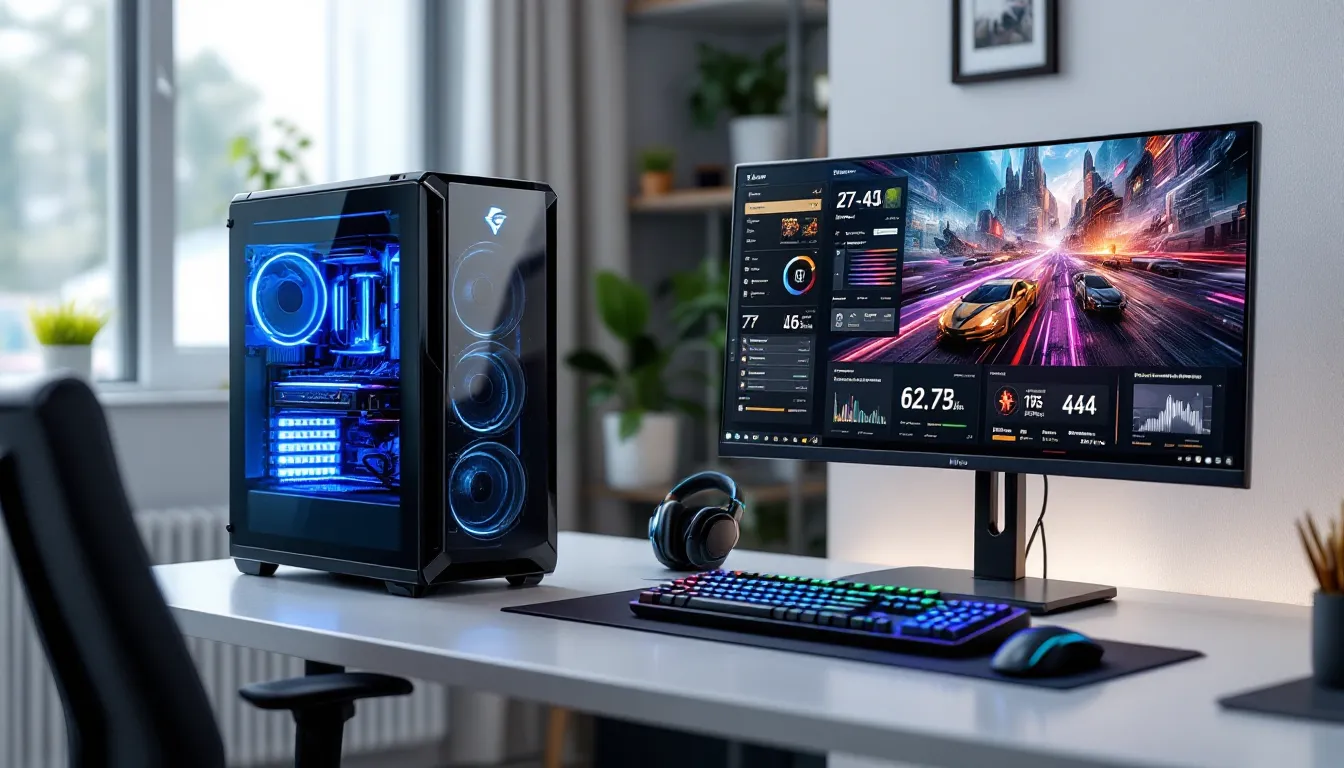
Shopping for a gaming PC can feel like navigating a minefield. You need a powerful GPU, a balanced CPU, enough RAM to avoid stuttering, a monitor that actually shows what your hardware can do, and peripherals that won’t break mid-clutch. Then there’s the question: do you piece it together yourself or let someone else handle it?
Gaming PC bundles promise to solve this headache by packaging everything into one purchase. But are they actually worth it, or are you just paying for convenience while sacrificing performance? In 2026, the bundle market has matured significantly, with options ranging from budget starter kits to high-end battlestations that include everything except the RGB mousepad. This guide breaks down what’s available, what to watch out for, and how to get the most bang for your buck without ending up with a drawer full of worthless peripherals.
Key Takeaways
- Gaming PC bundles offer legitimate value when components are properly balanced and peripherals align with your needs, saving $150–$400 compared to buying separately if you avoid inflated pricing illusions.
- Mid-range gaming PC bundles ($1,200–$1,800) deliver the best performance-to-value ratio, enabling 1440p high-refresh gaming with room for future GPU upgrades without diminishing returns.
- Verify exact GPU and CPU models rather than just series names, ensure RAM is dual-channel DDR5, and confirm the PSU has adequate wattage for future upgrades to avoid bottlenecks and compatibility issues.
- Bundle peripherals often cut corners with membrane keyboards, poor-quality mice, and boomy headsets—accept budget tiers as temporary placeholders and budget for quality replacements if you care about input performance.
- Enable XMP/DOCP RAM settings, update GPU drivers immediately, and optimize in-game settings individually rather than blindly selecting “Ultra” presets to extract maximum performance from your bundled system.
- PC bundles outperform current-gen consoles with higher framerates and better graphics flexibility, though total value depends on whether you prioritize upfront cost savings (consoles) or long-term upgrade potential and ecosystem flexibility (PC).
What Are Gaming PC Bundles and Why Should You Consider Them?
A gaming PC bundle is a packaged deal that combines the tower with peripherals, a monitor, or both. Instead of hunting down each component individually, you get a pre-selected setup designed to work together out of the box.
The appeal is obvious: convenience. You don’t need to verify motherboard compatibility, check PSU wattage, or spend hours reading monitor reviews. For first-time PC gamers or anyone upgrading from console, bundles eliminate decision paralysis.
But convenience isn’t the only draw. When done right, bundles offer legitimate value, and when done wrong, they’re a trap that leaves you replacing half the components within six months.
What’s Typically Included in a Gaming PC Bundle
Most bundles start with the tower, the actual gaming PC itself. This includes the GPU, CPU, motherboard, RAM, storage, PSU, and case. The quality here varies wildly, from genuinely competitive builds to glorified office PCs with a mid-tier GPU slapped in.
Beyond the tower, common bundle additions include:
- Monitor: Usually 24-27 inches, with specs ranging from basic 1080p 60Hz panels to 1440p 165Hz displays for competitive gaming
- Keyboard and mouse: Entry-level bundles often include membrane keyboards and basic optical mice, while premium packages offer mechanical keyboards and high-DPI gaming mice
- Headset: Typically stereo gaming headsets, though quality varies from tinny $20 models to surprisingly decent wireless options
- Mouse pad: Often thrown in as a bonus, though rarely worth mentioning
- Operating system: Windows 11 is usually pre-installed, saving you $100-140
Some manufacturers also include game codes, extended warranties, or RGB lighting controllers. The actual value depends entirely on the quality of what’s included, not just the fact that it’s bundled.
The Cost Savings: Bundle vs. Buying Separately
Here’s where it gets interesting. A well-constructed bundle can save anywhere from $150 to $400 compared to buying each component individually at retail price. Manufacturers leverage bulk purchasing power and existing inventory to discount the package.
Consider a mid-range example from early 2026: a bundle with an RTX 4070-powered PC, 1440p 144Hz monitor, mechanical keyboard, and decent wireless mouse might retail for $1,799. Buying these separately could easily hit $2,100-2,200.
The catch? Not all bundles deliver real savings. Some pad the package with cheap peripherals valued at inflated “retail prices” to create the illusion of a discount. A $50 keyboard listed as “$120 value” doesn’t save you money, it wastes drawer space.
The actual cost-benefit depends on three factors:
- Whether you’d actually buy the included peripherals separately
- The quality of those peripherals relative to alternatives at the same price point
- How much of the “savings” comes from genuinely discounted components versus inflated baseline pricing
For someone building their first setup, a good bundle beats piecing together parts. For experienced gamers who already own quality peripherals, bundles often force you to pay for redundant gear.
Types of Gaming PC Bundles Available in 2026
Not all bundles target the same gamer. Manufacturers segment offerings based on performance tier, and knowing which category fits your needs prevents both overspending and bottlenecking.
Entry-Level Bundles for Casual Gamers
Entry-level bundles typically range from $700 to $1,100 and target 1080p gaming at 60+ FPS in most titles. These setups prioritize getting you into PC gaming without requiring a second mortgage.
Common specs in this tier:
- GPU: RTX 4060, RX 7600, or occasionally previous-gen cards like the RTX 3060
- CPU: Intel Core i5-13400F or AMD Ryzen 5 7600
- RAM: 16GB DDR4
- Storage: 500GB-1TB NVMe SSD
- Monitor: 1080p 75-120Hz, often 24 inches
- Peripherals: Basic membrane keyboard, 3200 DPI mouse, stereo headset
These bundles handle esports titles (Valorant, CS2, League) at high framerates and run AAA games at medium-high settings. They won’t max out Cyberpunk 2077’s ray tracing, but they’re legitimate gaming machines, not glorified web browsers.
The main compromise is upgrade potential. Budget motherboards often limit future RAM expansion or PCIe lane availability, and the included PSU might not handle a significantly beefier GPU down the line.
Mid-Range Bundles for Competitive Gaming
The $1,200-1,800 sweet spot delivers serious performance for competitive and enthusiast gamers. This tier dominates sales because it offers 1440p high-refresh gaming without the diminishing returns of flagship components.
Typical mid-range specs:
- GPU: RTX 4070, RTX 4070 Super, or RX 7800 XT
- CPU: Intel Core i7-14700F or AMD Ryzen 7 7800X3D
- RAM: 32GB DDR5
- Storage: 1TB NVMe Gen 4 SSD
- Monitor: 1440p 144-165Hz, 27 inches, often IPS or VA panel
- Peripherals: Mechanical keyboard (usually red/blue switches), 16000+ DPI gaming mouse, wireless headset
This configuration maintains 144+ FPS in competitive shooters at 1440p and handles AAA titles with ray tracing enabled at playable framerates. The components also leave room for future upgrades, swap in a beefier GPU in two years, and the rest of the system keeps up.
Bundles in this tier from reputable retailers often include better quality peripherals that you won’t immediately replace. Independent hardware testing from sources like Tom’s Hardware regularly features these components in recommended builds, which is a good sanity check.
High-End Bundles for Enthusiasts and Streamers
Premium bundles start around $2,000 and can exceed $4,000 for absolute top-tier configurations. These target 4K gaming, high-refresh 1440p with maxed settings, content creation, and streaming.
High-end bundle characteristics:
- GPU: RTX 4080, RTX 4090, or RX 7900 XTX
- CPU: Intel Core i9-14900K or AMD Ryzen 9 7950X3D
- RAM: 64GB DDR5-6000+
- Storage: 2TB+ NVMe Gen 4 or Gen 5 SSD
- Monitor: 4K 144Hz or ultrawide 1440p 240Hz, often with HDR600+ and G-Sync/FreeSync
- Peripherals: Premium mechanical keyboard (hot-swappable switches, PBT keycaps), flagship wireless mouse, high-end wireless headset with spatial audio
These systems don’t just game, they encode OBS streams at high bitrates without dropping frames, render video projects, and run heavily modded games without breaking a sweat. The monitors alone often cost $600-1,200, making the bundle’s total value proposition significantly different than budget tiers.
The trade-off is diminishing returns. A $3,500 bundle won’t deliver twice the gaming experience of a $1,750 setup, but it will handle workloads and edge cases that mid-range hardware struggles with.
Pre-Built vs. Custom Bundles: Which Is Right for You?
The bundle landscape splits into two approaches: pre-configured packages sold as fixed SKUs, and custom bundles where you select base components and add peripherals à la carte.
Pre-built bundles offer zero flexibility but maximum convenience. The manufacturer has already chosen every component, tested the configuration, and priced it as a single unit. You can’t swap the GPU for a better model or skip the included headset.
The upside? These bundles often hit aggressive price points because manufacturers can optimize purchasing and assembly for specific configurations. Major retailers move these in volume during seasonal sales, sometimes hitting genuinely impressive discounts.
The downside is compromise. You might get a great GPU paired with a mediocre motherboard, or a fantastic monitor bundled with peripherals you’ll never use. Pre-built bundles work best when the entire package aligns with your needs, if even two components feel like concessions, you’re better off elsewhere.
Custom bundles let you configure the PC itself (choosing GPU, CPU, RAM, storage) and then add peripherals from a selection of compatible options. Boutique PC builders like iBuyPower, NZXT BLD, and others offer this approach.
This flexibility solves the “forced peripheral” problem. Already own a solid keyboard? Skip it and redirect that budget toward a better GPU. Need a specific monitor size for your desk? Choose from three or four options rather than accepting whatever ships.
The trade-off is price and decision fatigue. Custom bundles rarely hit the rock-bottom pricing of mass-produced pre-builts, and you still need to make informed choices about component balance. You’re getting semi-custom convenience, not full DIY control, and not pre-built simplicity.
Which approach wins depends on your situation:
- First gaming PC, limited knowledge: Pre-built bundle from a reputable brand
- Upgrading from console, specific peripheral preferences: Custom bundle where you control peripheral selection
- Experienced gamer with existing peripherals: Probably neither, buy the tower separately
Neither option is inherently superior. The question is whether the specific bundle’s configuration and price align with what you’d choose if buying components individually.
Key Components to Look for in a Gaming PC Bundle
Not all bundles are built equal. Manufacturers sometimes hide cost-cutting measures behind flashy marketing, and knowing where to look prevents expensive disappointments.
Graphics Card and Processor Performance
The GPU is the single most important component for gaming performance. Everything else exists to support it. When evaluating bundles, verify the exact GPU model, not just the series.
For example, “RTX 4060” sounds decent, but the RTX 4060 Ti offers significantly better performance for a small price jump. Similarly, AMD’s RX 7600 XT and RX 7700 XT sit in different performance tiers even though similar naming.
In 2026, expect these GPU-to-resolution pairings:
- 1080p high settings: RTX 4060, RX 7600 minimum
- 1440p high settings: RTX 4070, RX 7800 XT recommended
- 4K high settings: RTX 4080, RX 7900 XTX or better
The CPU matters less for pure gaming but prevents bottlenecks and supports multitasking (streaming, Discord, browser tabs). Bundles should pair GPUs with appropriate processors:
- RTX 4060-class GPUs: i5-13400F or Ryzen 5 7600 minimum
- RTX 4070-class GPUs: i7-14700F or Ryzen 7 7800X3D ideal
- RTX 4080+ GPUs: i9-14900K or Ryzen 9 7950X3D to avoid CPU bottlenecks
Beware bundles that pair high-end GPUs with budget CPUs or vice versa. A $500 GPU paired with a last-gen i5 creates bottlenecks in CPU-heavy games. A Ryzen 9 paired with an RTX 4060 wastes money you could’ve spent on a better GPU.
RAM, Storage, and Future Upgrade Potential
RAM requirements have plateaued at 16GB for most gaming, but 32GB is increasingly standard in mid-range and up bundles. DDR5 has become the norm in 2026, though DDR4 systems still exist in budget tiers.
Red flags:
- Single-channel RAM (1 stick instead of 2) cripples performance by 10-20% in many games
- 8GB total RAM in any gaming bundle marketed for 2026 gaming
- Slow DDR4-2666 or DDR5-4800 when faster options add negligible cost
Storage should start at 500GB NVMe SSD minimum, with 1TB being standard. Avoid bundles that include old SATA SSDs or, worse, mechanical HDDs as the primary drive. Game install sizes continue growing, Call of Duty alone can exceed 200GB.
Check if the motherboard and case support additional storage. A single M.2 slot with no room for expansion means you’ll hit capacity fast and face expensive external solutions.
Upgrade potential matters if you plan to keep the system beyond two years. Key questions:
- Does the PSU have adequate wattage for a future GPU upgrade? (600W minimum for mid-range, 850W+ for high-end)
- Does the motherboard support higher-end CPUs from the same generation?
- Are additional RAM slots available?
- Does the case fit larger GPUs and offer decent airflow?
Budget bundles often skimp here, using just-adequate PSUs and locked chipsets that make upgrades painful.
Monitor Specifications: Refresh Rate and Resolution
The bundled monitor can make or break the experience. A powerful PC paired with a 1080p 60Hz monitor is like buying a sports car and driving it in a school zone.
Minimum specs by bundle tier:
- Entry-level: 1080p, 75Hz+, IPS or VA panel
- Mid-range: 1440p, 144Hz+, IPS preferred
- High-end: 1440p 240Hz or 4K 144Hz, IPS with HDR
Refresh rate directly impacts competitive gaming. The difference between 60Hz and 144Hz is immediately noticeable in shooters, MOBAs, and any fast-paced game. Once you’ve experienced high refresh, 60Hz feels choppy.
Panel type matters too. TN panels offer fast response times but poor color and viewing angles. IPS provides better colors and viewing angles with acceptable response times. VA sits between them with deeper blacks but potential ghosting.
Response time should be under 5ms, ideally 1ms for competitive gaming. Adaptive sync (G-Sync or FreeSync) eliminates screen tearing and should be standard in any 2026 bundle.
Beware bundles advertising “curved gaming monitors” without specifying refresh rate or resolution, sometimes that’s code for a mediocre 1080p 75Hz VA panel in a fancy shell.
Peripheral Quality: Keyboard, Mouse, and Headset
Peripherals are where bundles most often cut corners. A genuinely good mouse costs $50-80, a solid mechanical keyboard runs $80-150, and decent wireless headsets start around $70. Budget bundles can’t include all three at quality levels without destroying margins.
Common compromises:
- Membrane keyboards marketed as “gaming keyboards” with rainbow LEDs but mushy, unresponsive keys
- Mice with high DPI counts (“16,000 DPI.”) but poor sensors, uncomfortable shapes, and cheap switches that double-click within months
- Headsets with boomy bass, muffled mids, uncomfortable earpads, and microphones that sound like you’re underwater
Entry-level bundles almost always include throwaway peripherals. Accept this reality and budget for replacements if you care about input quality. Mid-range bundles sometimes surprise with decent mechanicals (usually Outemu or Gateron switches) and recognizable mouse brands.
High-end bundles occasionally include flagship peripherals, but verify the specific models. Testing reviews from outlets covering gaming hardware performance help separate marketing from reality.
If the bundle doesn’t specify peripheral brands and models, assume they’re generic. Reputable bundles highlight peripheral quality because it’s a selling point, vagueness means corner-cutting.
Where to Find the Best Gaming PC Bundle Deals
Bundle pricing fluctuates dramatically based on where and when you buy. Knowing when retailers discount aggressively and which sources offer genuine value saves hundreds of dollars.
Online Retailers and Seasonal Sales
Major online retailers dominate the bundle market: Amazon, Newegg, Best Buy, and Micro Center (if you’re near a physical location). Each has seasonal patterns worth tracking.
Black Friday and Cyber Monday remain the biggest discount periods, with bundles often hitting 15-25% below regular pricing. Manufacturers clear inventory for new component launches, creating legitimate deals on previous-gen hardware that’s still highly capable.
Back-to-school sales (late July through August) target students and offer competitive bundle pricing, though selection is often smaller than holiday sales.
Post-CES and post-Computex periods (February and June) sometimes see clearance on older bundles as retailers make room for newly announced hardware. These deals require flexibility, you’re buying last year’s GPU generation at a discount, which is fine if the performance still meets your needs.
Prime Day, Memorial Day, and Labor Day offer inconsistent bundle deals. Sometimes you’ll find competitive pricing: other times it’s marginal discounts on already overpriced packages.
Price tracking tools help identify genuine deals versus artificial inflation. CamelCamelCamel for Amazon and Newegg’s price history feature show whether a “sale” actually reduces the price or just strikes through an inflated MSRP.
Retailer-specific considerations:
- Newegg: Often bundles components themselves rather than selling pre-packaged deals: requires more knowledge but offers flexibility
- Best Buy: Generous return policy (usually 15 days) helps if the bundle disappoints
- Micro Center: In-store-only bundles sometimes beat online pricing significantly, and staff can answer technical questions
- Amazon: Convenient returns but watch for third-party sellers inflating prices on popular bundles
Manufacturer Direct Bundles
Buying directly from NZXT, iBuyPower, Origin PC, CyberPowerPC, and similar builders offers customization and sometimes exclusive configurations not available through retailers.
Manufacturer-direct benefits:
- Custom bundle building: Configure the PC precisely and add only peripherals you need
- Warranty consolidation: Single warranty covering entire system, not separate warranties per component
- Seasonal financing: Many offer 0% APR financing during promotional periods
- Exclusive models: Access to case designs and configurations not sold through third-party retailers
Trade-offs include longer wait times (custom builds ship in 2-4 weeks versus immediate Amazon delivery) and prices that rarely match the rock-bottom deals major retailers hit during aggressive sales.
Manufacturer bundles make sense when:
- You want specific customization not available in pre-packaged bundles
- You value consolidated warranty support over multi-vendor dealing
- You’re not constrained by immediate need
Direct buying works less well if you’re hunting absolute lowest price or need the system within days. Industry coverage from sites tracking hardware deals often highlights manufacturer-specific promotions worth monitoring.
Common Pitfalls to Avoid When Buying Gaming PC Bundles
The bundle market contains genuine value and absolute garbage. Recognizing red flags before purchase prevents buyer’s remorse and wasted money.
Underpowered Components Hidden in Attractive Packaging
Marketing language obscures performance reality. Terms like “gaming PC” and “VR ready” are legally meaningless and cover everything from genuinely capable systems to barely-functional e-waste.
Watch for these deceptive practices:
Vague GPU descriptions: “Dedicated graphics card” or “4GB graphics” without specifying the model means it’s probably a terrible GPU they don’t want to name. Legitimate bundles specify exact models: “NVIDIA RTX 4060” or “AMD RX 7600.”
Unbalanced configurations: A Ryzen 9 CPU paired with 8GB RAM and a budget GPU wastes money on the processor that should’ve gone to graphics and memory. This happens when manufacturers bundle clearance-price CPUs to create an impressive-sounding spec sheet.
Previous-generation hardware at current-gen pricing: An RTX 3060 bundle in 2026 should cost significantly less than an RTX 4060 bundle with otherwise identical specs. Some retailers hope buyers won’t notice they’re paying current prices for outdated hardware.
Inadequate cooling: Budget bundles sometimes skimp on case fans and CPU coolers. A single exhaust fan and stock Intel cooler might technically work, but thermal throttling will cripple performance under load. Check reviews mentioning thermals, if the system hits 95°C during gaming, components will throttle and degrade faster.
No-name PSUs: Power supplies from unknown brands fail catastrophically and take other components with them. Reputable bundles specify PSU brands: EVGA, Corsair, Seasonic, Thermaltake, or similar. “550W power supply” with no brand or efficiency rating is a massive red flag.
If a bundle seems unusually cheap for its spec sheet, it’s cutting corners somewhere. Find out where before buying.
Low-Quality Peripherals That Need Immediate Replacement
Bundles inflate apparent value by including peripherals with exaggerated “retail values.” That “$400 in accessories included.” claim often breaks down as:
- $20 membrane keyboard listed at “$80 value”
- $15 mouse listed at “$60 value”
- $25 headset listed at “$100 value”
- $10 mousepad listed at “$30 value”
- Inflated monitor pricing
The actual value you receive is what those items would cost to replace with equivalents, not the fictional MSRP the manufacturer claims.
Red flags in peripheral specifications:
Keyboards: “Gaming keyboard” with no mention of mechanical switches is a membrane keyboard. “RGB lighting” doesn’t make it good, it makes it colorful garbage if the switches and build quality are terrible.
Mice: Extremely high DPI numbers (“20,000 DPI.”) without mentioning sensor manufacturer. Good gaming mice specify Pixart or similar quality sensors. Also watch for ergonomics, generic symmetrical shapes with sharp edges become uncomfortable during extended sessions.
Headsets: “7.1 surround sound” in a $30 headset is simulated through stereo drivers and usually sounds worse than decent stereo imaging. “50mm drivers” is meaningless without knowing driver quality. Absent frequency response specifications suggest the manufacturer doesn’t want you to know how bad they sound.
The solution isn’t avoiding all bundled peripherals, it’s being realistic about their quality. Budget bundle peripherals serve as temporary placeholders until you can upgrade. Don’t pay a premium for a bundle based on peripheral “value” you’ll immediately replace.
How to Maximize Value from Your Gaming PC Bundle
Getting the bundle home is step one. Extracting maximum performance and longevity requires optimization and planning.
Optimizing Settings for Peak Performance
New bundle owners often leave performance on the table through default settings. Take an hour after setup to optimize:
Enable XMP/DOCP for RAM: Motherboards default RAM to slow speeds (usually 2133MHz or 4800MHz). Entering BIOS and enabling XMP (Intel) or DOCP (AMD) runs RAM at its rated speed, boosting performance by 5-15% in many games.
Update GPU drivers: Pre-installed driver versions are often months old. Download latest drivers from NVIDIA or AMD, game-specific optimizations and performance improvements accumulate quickly.
Adjust in-game settings: Don’t just select “Ultra” preset. Some settings (shadows, ambient occlusion, volumetric effects) tank framerate for minimal visual improvement. Dial back the worst offenders while keeping texture quality and view distance high. The difference between “High” and “Ultra” is often 15% performance for 2% visual quality.
Monitor temperatures: Use HWInfo64 or similar to track GPU and CPU temps during gaming. If either consistently exceeds 85°C, improve case airflow (add fans), verify case intake vents aren’t blocked, or adjust fan curves in BIOS.
Disable unnecessary startup programs: Pre-builts often include bloatware. Use Task Manager’s startup tab to disable manufacturer utilities you don’t need, RGB software for peripherals you aren’t using, and any trial antivirus software (Windows Defender is adequate for most users).
Configure monitor settings: Verify the monitor actually runs at its rated refresh rate (Windows often defaults to 60Hz). Right-click desktop > Display Settings > Advanced Display > choose the correct refresh rate. Also enable G-Sync or FreeSync in both GPU control panel and monitor OSD.
These adjustments take minimal time and significantly improve the experience relative to out-of-box defaults.
Planning Your Upgrade Path
Even excellent bundles eventually need upgrades. Planning this path before components become bottlenecks prevents reactive, expensive decisions.
Identify the first bottleneck: In most systems, the GPU ages fastest relative to gaming demands. Plan to upgrade graphics cards every 3-4 years if you maintain high/ultra settings. The CPU, RAM, and storage typically remain adequate longer.
Verify upgrade compatibility before buying the bundle: Check motherboard specifications. Does it support next-gen CPUs, or is your current CPU the best it will ever accept? Are there open RAM slots for adding capacity? Does the PSU have overhead for a more power-hungry GPU?
Budget incremental upgrades: Don’t plan to replace everything at once. A realistic three-year upgrade path might be:
- Year 1: Add 1TB storage if needed
- Year 2: Upgrade GPU
- Year 3: Add RAM if 16GB becomes limiting
- Year 4+: Consider platform refresh (new motherboard, CPU, RAM together)
Sell replaced components: GPU, RAM, and storage retain resale value. Selling your RTX 4070 when upgrading to a 5070 recoups 40-50% of the new card’s cost if done relatively soon after upgrade.
Monitor technology shifts: Major platform changes (new RAM generation, socket change, connectivity standards) sometimes make sense as hard reset points where you rebuild rather than incrementally upgrade. Trying to keep a DDR4 platform alive indefinitely makes less sense than fresh DDR5 build when performance gaps widen.
The beauty of PC gaming is upgradability. Even budget bundles can evolve into respectable systems through strategic component refreshes.
Gaming PC Bundles vs. Console Gaming: The 2026 Comparison
The PC-versus-console debate has raged for decades, but 2026’s landscape offers clearer comparison points than ever.
Upfront cost still favors consoles. A PS5 or Xbox Series X costs $500-550, while entry-level PC bundles start around $700-800 and mid-range bundles hit $1,200-1,500. That $700 gap is real money.
But total cost of ownership tells a different story. PC games frequently sell for less through Steam sales, Humble Bundle, and Epic giveaways. Console games maintain higher prices longer, and PlayStation/Xbox online subscriptions add $80/year. Over a console’s 6-7 year lifespan, the subscription alone costs $480-560.
Performance and flexibility heavily favor PC bundles. Even mid-range bundles significantly outperform current-gen consoles, delivering higher framerates, better graphics settings, and support for ultrawide monitors or high-refresh displays consoles can’t drive. You also get access to PC-exclusive titles, mods, and customization consoles don’t allow.
Convenience is consoles’ remaining advantage. They’re plug-and-play, never require driver updates or settings tweaking, and guarantee every game works without troubleshooting. For gamers who just want to play without thinking about hardware, that simplicity has value.
Upgrade path doesn’t exist for consoles, you buy hardware in 2026 and live with it until 2030+. PC bundles let you upgrade GPU, add RAM, or expand storage whenever performance feels limiting. Your $1,200 bundle today can become a $1,500 system in two years with just a GPU swap, extending its competitive lifespan significantly.
Ecosystem lock-in matters too. PlayStation and Xbox lock purchases to their platforms, your digital library becomes worthless if you switch ecosystems. PC games generally work across hardware upgrades indefinitely. That Steam library you build in 2026 still works in 2036.
The honest answer: consoles make sense for casual gamers prioritizing simplicity and lowest upfront cost. PC bundles make sense for anyone wanting better performance, flexibility, or planning to game seriously for years. There’s no universal winner, just different priorities.
For competitive gamers, content creators, or anyone who values high refresh rates and maximum settings, PC bundles aren’t debatable. For someone gaming a few hours weekly and primarily interested in single-player console exclusives, a PlayStation makes perfect sense. Know which category you’re in before deciding.
Conclusion
Gaming PC bundles in 2026 offer more legitimate value than ever before, if you choose carefully. The market has matured past the days when bundles meant universally overpriced garbage paired with e-waste peripherals.
Good bundles exist at every price point. You can start PC gaming for $700-800 with genuinely capable entry-level packages, or build a complete battlestation for $2,000+ that handles any game at maximum settings while streaming. The key is knowing what to look for and what to avoid.
Verify exact component models, not just series names. Check whether peripherals are actually worth using or just inflating the “value” claim. Understand whether you need everything in the bundle or if you’re paying for redundant gear. And never assume a bundle is a deal just because it’s marketed as one, verify pricing against buying components separately.
The best bundle is whichever one delivers the performance and features you need without forcing compromises on components you care about. Sometimes that’s a pre-configured package during a Black Friday sale. Sometimes it’s a custom bundle where you select exactly what you want. And sometimes the best “bundle” is no bundle at all, just buying the components that matter to you.
Whatever you choose, you’re getting into PC gaming at a great time. Hardware is powerful, options are plentiful, and bundles, when chosen wisely, offer genuine convenience and savings. Just do your assignments first.
About Author