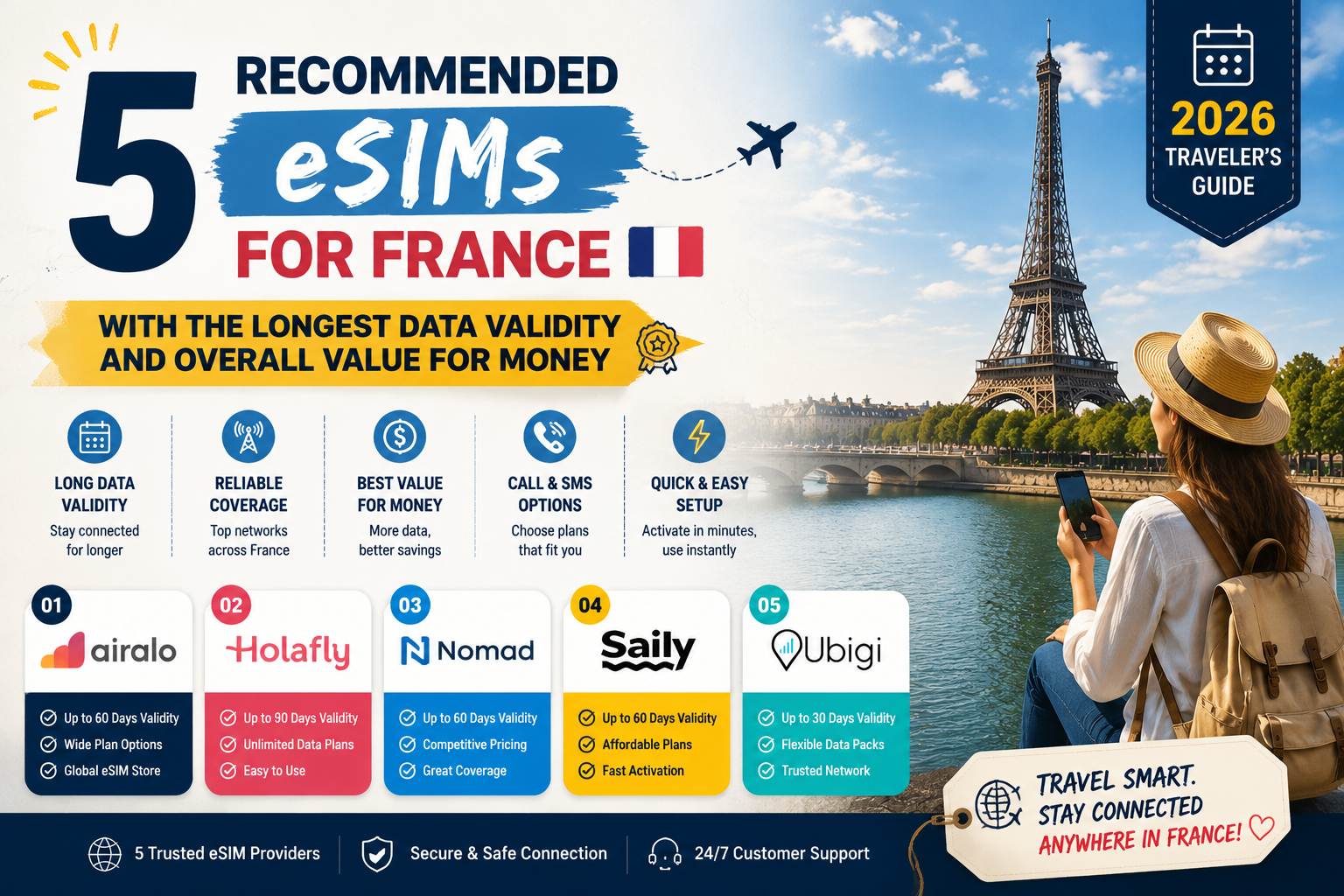
TL;DR
- Longest validity window: Ubigi – a renewing monthly allowance across 12 months.
- Best value for money: Saily – a 30-day window plus 115+ virtual locations, ad blocking and web protection in-app.
- Biggest data buckets: Nomad – 50 GB across 30 days.
- Reusable eSIM, no shelf life: Orange Travel – fixed 14, 30 and 90-day windows at full speed, with no expiry clock ticking on an unused plan.
- Auto-renews before you run dry: Airalo – tops up automatically once your data drops below 10%, across six window lengths from 3 to 30 days.
- Coverage won’t be your tiebreaker: all five ride the same four French networks, so judge them on validity, price and what comes bundled in, not on signal.
Ubigi holds the longest data validity of any eSIM for France, and Saily takes the value crown behind it. Saily’s 30-day plans run shorter than Ubigi’s twelve-month allowance, but they are the only ones that arrive with a security layer already in the box.
Behind them, Nomad packs the biggest single-country bucket, Orange Travel’s eSIM never expires while it waits unused in your app, and Airalo tops itself up automatically before you run dry, each a better fit for a particular shape of trip.
A France eSIM runs on two clocks, and almost nobody explains the second one. The shelf-life clock decides how long an unactivated plan waits for you. The validity clock starts the moment your phone touches a French network, and it does not pause for the days your phone spends in your bag.
A note on how we work: none of the links below are affiliate links, so we make no commission from any of the providers mentioned. This is an honest, independent assessment from start to finish.
How eSIM Validity Works in France, and What to Judge It On
Because the validity clock only starts on connection, you can buy early and install at home without burning a day. The shelf-life clock is the one that trips people up: when a provider’s limit on an unactivated plan runs out, it starts on its own, whether you have left home or not. Here is where each provider draws that line:
- Ubigi: an unused plan expires six months after purchase.
- Saily: activates on arrival, or 30 days after purchase, whichever lands first.
- Nomad: activates within 60 days, or the expiry clock starts on its own.
- Orange Travel: a reusable eSIM with no fixed shelf life, so you activate the plan whenever you are ready.
- Airalo: validity begins when the eSIM connects to a French network.
Saily’s 30-day shelf life obliterates a plan bought in March for a July trip. That is a spec, not a defect: the same auto-activation that lets you install at home and land already connected is exactly what stops an unused plan from waiting indefinitely, and 30 days is simply where Saily draws that line. It is one of the few numbers worth checking before you pay.
Roaming will not rescue you either. The European Commission states that Roam Like at Home “is intended for periodic traveling,” with a surcharge available past roughly four months abroad [1]. Fly in from the US, the UK, Canada, or Australia, and it never covered you at all.
This guide judges each provider on four things: the validity window, the shelf life, the data ceiling, and what a dollar buys once you count everything in the box. Coverage barely separates them, because all five ride the four French networks Arcep tracks [2].
Prices were confirmed on live sites in July 2026, with eSIM adoption set to accelerate from 2026, according to GSMA Intelligence’s forecast [3].
The 5 Best eSIMs for France in 2026
|
Provider |
Best For |
Longest Validity |
Shelf Life Before Auto-Start |
|
Ubigi |
Longest validity window |
12 months (annual plan) |
6 months |
|
Saily |
Best value for money |
30 days |
30 days |
|
Nomad |
Biggest data buckets |
30 days (year-long on Global-EX) |
60 days |
|
Orange Travel |
Reusable eSIM, no shelf life |
90 days |
Reusable eSIM, no fixed shelf life |
|
Airalo |
Auto-renews before you run dry |
30 days |
Starts on network connection |
1. Ubigi – Longest validity window
Ubigi sells France data on two tracks: one-off traveler plans and a subscription that renews a monthly allowance for a full year on one upfront payment. Ubigi is a brand of Transatel, now part of NTT, so it holds direct carrier relationships rather than reselling wholesale. Its one-off plans run to 30 days: 10 GB for US$10, 25 GB for US$19, and a top plan at US$39 that eases to 2 Mbps after 60 GB.
Pros:
- The only plan here that renews an allowance monthly across a full 12 months
- An unactivated plan sits six months before expiring, the longest shelf life on this list
- Prices a 10 GB month at US$1.00 per gigabyte, half what Saily charges
Cons:
- Support runs through a help centre and contact form, not 24/7 live chat
- The annual plan cannot be cancelled once purchased
- No virtual location, ad blocking or web protection in the app
Best for: Expats, students, and remote workers settling in France for months rather than weeks.
Key details:
Coverage: multi-country, one profile across many destinations
Support: Help centre and email
2. Saily – Best value for money
Saily sells country, regional, and global eSIM data through an app that also ships ad blocking and malicious-site protection. Saily is built by Nord Security, the company behind NordVPN, and it is the travel eSIM that ships online protection (115+ virtual locations, an ad blocker, and malicious-site blocking) inside the same app that sells the data.
Saily also runs an unlimited data plan on Saily Ultra and an optional Saily phone number for calls and texts, so it is a data eSIM that does more than sell you data and stop.
Saily prices France plans from US$3.99 for 1 GB over 7 days up to US$31.99 for 20 GB over 30 days, with Saily’s unlimited data plan sold in windows from 10 to 30 days. Apple’s App Store lists the developer as Nordvpn S.A. and rates the app 4.7 on the US storefront, which makes that Nord lineage checkable rather than a marketing line.
https://www.youtube.com/watch?v=ZgjVmKK8Xfk
“Bought 1gb for 3 days in London and 10gb for 30 days in Spain (was only there for 14 days but that wasn’t an option). Left each country with data to spare. So I spent a total of about $21. My carrier’s International Plan would have cost $170.” – adman17, App Store review (June 2024)
Pros:
- Saily’s unlimited data plan on Saily Ultra carries a heavy trip without a per-gigabyte tally
- Saily’s optional phone number adds calls and texts on top of the data plan, which most travel eSIMs do not offer at all
- Ships 115+ virtual locations, an ad blocker and malicious-site blocking in the app, which no competitor here offers at any price
- One Saily eSIM covers every destination: add the next country and top up, instead of installing a fresh profile each time
- Plans activate automatically on arrival, so you install at home and land connected
- Data alerts at 80%, and 24/7 live chat when something breaks at 2am
Cons:
- Not the outright cheapest per gigabyte on a small plan, if raw price is the only thing you are weighing
Best for: Travelers spending two to four weeks in France who would otherwise buy a travel VPN on top of the data.
Key details:
Coverage: 200+ destinations
Support: 24/7 live chat
3. Nomad – Biggest data buckets
Nomad prices France data by the gigabyte and sells the largest single-country bucket in this guide: 50 GB across 30 days for US$35. Its plans ride on all four French networks rather than one partner, and hotspot is supported. Nomad also gives you 60 days to activate before the clock starts, double Saily’s window.
Pros:
- The 50 GB / 30-day plan is the biggest single-country allowance here
- A 60-day activation window, so a plan bought two months early still waits
- Global-EX plans reach year-long coverage for frequent flyers
Cons:
- Nomad’s largest France plans cap high-speed data per day, then slow to 512 kbps
- Country plans cap at 30 days, so a three-month stay means stacking add-ons
- Data-only, with no in-app security tools
Best for: Heavy data users on a month-long trip who want one large allowance, bought once.
Key details:
Coverage: 200+ destinations
Support: 24/7 live chat
4. Orange Travel – Reusable eSIM, no shelf life
Orange Travel sells France and Europe eSIMs directly from Orange, a major European carrier, and the eSIM itself is reusable with no shelf life, so it sits ready until you’re actually there to activate it. Its Europe plans come in three fixed windows: 20 GB over 14 days at €24.99, 50 GB over 30 days at €44.99, and a 500 GB plan running 90 days. It bundles calls and SMS with the data too, but the reason to reach for it is that nothing about the eSIM expires while it waits in your app, not any single add-on.
Pros:
- A reusable eSIM with no fixed shelf life, so an unactivated plan never starts its own expiry countdown
- The 500 GB Europe plan is one of the largest single-purchase data buckets in this guide
- The 90-day Europe window is the longest single-purchase validity here
Cons:
- Europe plans start at €24.99, the highest minimum spend here, so a light user buys data they will not touch
- The 14-day window is a hard stop, awkward for an 18-day trip
- Headline prices carry rotating discounts, so today’s number may not be next month’s
Best for: Travelers who buy well ahead of their trip and don’t want an eSIM to expire before they leave, or who are crossing several EU borders on one plan.
Key details:
Coverage: Europe, 40+ countries
Support: 24/7 support
5. Airalo – Auto-renews before you run dry
Airalo builds automatic top-ups into its eSIM plans: once your data drops below 10%, it renews itself so you’re not left checking a meter mid-trip. Its France packages come in six window lengths: 3, 5, 7, 10, 15, and 30 days, priced from US$11 to US$65, with standard fixed-data packages starting at US$4.00.
If your trip is nine days, Airalo is also the only provider here that sells you close to nine days instead of rounding up to a month.
Pros:
- Auto-renewal kicks in automatically once a plan drops below 10% data, so you’re not stuck watching a meter mid-trip
- Six separate window lengths, the finest-grained choice in this guide
- 24/7 chat, including WhatsApp, for help mid-trip
Cons:
- Country plans cap at 30 days, so long stays mean repeat purchases
- You install a new eSIM profile per destination rather than adding countries to one
- No in-app security tools like ad blocking or web protection
Best for: Travelers who don’t want to babysit their data balance, and anyone whose trip falls between the usual 7- and 30-day windows.
Key details:
Coverage: one of the widest destination lists in the category
Support: 24/7 chat, including WhatsApp
How to Match an eSIM to Your Trip
Your trip length decides the pick here, not the brand. Match your situation:
- A long weekend in Paris: Airalo’s 3- or 5-day package. Nothing else sells a window that short.
- Two to four weeks: Saily gives you the most for the money. The window fits the trip, the security layer is included rather than sold separately, and the same eSIM carries into Italy or Spain afterwards.
- Three months or more: Ubigi’s annual plan. It is the only product built for a stay measured in months and the cheapest per gigabyte while it does it.
- Buying weeks or months before you travel: Orange Travel’s eSIM has no shelf life, so it waits untouched until you actually activate it.
- Heavy data on one trip: Nomad’s 50 GB bucket costs less than most rivals charge for 20 GB.
FAQs
How much does an eSIM for France cost in 2026?
Entry-level France plans cost around US$4 for 1 GB over 7 days, across Saily, Nomad, and Airalo alike. A 10 GB, 30-day plan runs from US$10 with Ubigi to roughly US$20 with Saily, as of July 2026.
Do eSIMs expire, and what happens to unused data?
Yes, eSIM plans expire, and you lose whatever data is left in them. Once the validity window closes, no provider here refunds the unused portion or rolls it over. Size the plan to the trip, not to a bigger bucket.
When does the validity clock actually start?
The eSIM starts your countdown when it connects to a French mobile network, not when you buy. The shelf-life clock is the one to watch: Saily gives you 30 days before auto-activation, Nomad 60, and Ubigi six months.
What makes Saily different from other travel eSIMs?
Saily comes from Nord Security, the team behind NordVPN, and it bundles security tools most eSIM apps do not ship at all: 115+ virtual locations, an ad blocker, and blocking for malicious sites. Saily also runs an unlimited data plan and an optional phone number for calls and texts, and it lets you add destinations to one existing Saily eSIM instead of installing a fresh profile per country.
Is Saily worth it if Ubigi is cheaper per gigabyte?
Ubigi beats Saily on raw price per gigabyte, so buy Ubigi if that is your only measure. Saily earns its place once you count what arrives with the plan: the security tools you would otherwise pay a VPN subscription for are already included, Saily’s unlimited data plan and optional calls and texts are there if you need them, and one Saily eSIM carries across 200+ destinations rather than stranding leftover validity in one country.
The Bottom Line
Ubigi offers the longest data validity for any eSIM in France in 2026, and if you are staying for months, buy it. Saily takes the best value for money for everyone else: a 30-day window that fits a real trip, plans that activate on arrival, and a security layer none of the others bundle into the box. Nomad hands you the biggest single bucket of data for a heavy month, Orange Travel is the one to buy well ahead of a trip since its eSIM never starts its own countdown, and Airalo is the one that tops itself up automatically before you run dry, with windows fine enough to sell you exactly nine days.
Check if your handset is eSIM-capable and carrier-unlocked, then buy the window that fits the trip rather than the one that looks biggest.
References:
- European Commission. (2024). Roaming: connected anywhere in the EU at no extra charge. https://digital-strategy.ec.europa.eu/en/policies/roaming
- Arcep. (2026). Observatoire du déploiement 5G – juin 2026. https://www.arcep.fr/cartes-et-donnees/nos-cartes/deploiement-5g/observatoire-du-deploiement-5g-juin-2026.html
- GSMA Intelligence. (2025). Consumer eSIM: device and MNO service trackers, and adoption forecast to 2030. https://www.gsmaintelligence.com/research/consumer-esim-device-and-mno-service-trackers-and-adoption-forecast-to-2030
About Author